Apple and the rest of us...a different view

Posted by Hitarth Jani | 4:35 AM | 0 comments »

Tim Leberecht, in a Matter/Anti-Matter blog post, asks whether Apple's "shock and awe" approach to product announcements is a dinosaur in a Web 2.0 world. I think there are a couple of other points worth making for perspective on this.

First, Apple has shifted dramatically from purely relying on big announcements at big events. It used to be, until just a few years ago, that Apple really only had two times each year that it made major hardware announcements: Macworld expos in San Francisco and New York. The developers conference was used for software announcements. Between them was pretty much a desert.

Today, Apple makes announcements throughout the year, sometimes at other shows like the NAB. This has allowed the company to spread the much larger quantity of announcements around, and makes the Macworld announcements more focused. It surely also makes managing the larger product pipeline easier.

So while the expo is still the highpoint of the year, it is not fair to characterize it as Apple only having two real opportunities per year to make announcements and news, as Frank Shaw does. While the other venues are not as big as the mass-market-oriented Macworld, they are geared toward their niche audiences with appropriate announcements. And besides, two major events a year is one more than many consumer electronics companies have, which put all their eggs in CES....

Second, Apple has become much better about spreading the word through other means than the expos. Starting with the iconic Think Different and iPod campaigns, Apple has reinvigorated its advertising efforts with large infusions of cash and creativity. And the Apple Stores have been very successful at attracting new customers and maintaining interest for existing Mac users.

As Mr. Shaw puts it: "But I'm a huge believer in the value of ongoing communication, to the right audiences, about the topics they care most about, in a regular, sustained way." It seems to me that with the stores, advertising, and targeted product announcements, this is exactly what Apple is doing.

Lastly, let's also think about how Apple itself builds up excitement before Macworld. Aside from occasional teasers that are void of any information (such as the last one, "something is in the air"), it pretty much does nothing. It is famously tough on clamping down on leaks, and only sporadically gives previews to select journalists like David Pogue.

Ninety-nine percent of the excitement and momentum is generated by the user base, the media, the blogosphere, essentially doing Apple's work for it. Most companies would kill for that kind of free publicity. If the announcements don't live up to the hype, that's not because Apple itself has controlled what the hype should be about, but because Apple has an enviable track record of blockbuster announcements.

Toshiba Portege Goes Up Against Macbook Air

Posted by Hitarth Jani | 5:52 AM | 0 comments »

Toshiba's new ultra-slim and lightweight Portégé R500 notebook has built-in 3G mobile broadband.

Toshiba plans to put a polite boot into Apple's hyped Macbook Air with a new version of its Portégé R500 notebook featuring built-in 3G mobile broadband.

The Japanese manufacturer points out that its lightweight laptops are thinner, lighter and more capable than Steve Jobs' new machine, and they cost less as well.

The Macbook Air is a triumph of marketing and of Apple managing its fans' expectations, said Ken Chan, Toshiba's U.K. product manager.

"I think Apple made compromises for [the sake of] design," he said. "For Apple, less is more. It is in the unique position of having a strong following of people who are willing to pay a £200 premium to get its products."

He added: "We have an abundance of connectivity features, it makes ours less of a hassle to carry it around than the Apple."

The R500 not only has 3G connectivity, it also has three USB ports to Air's one, and it includes an internal DVD drive, removable battery, a full-size DVI video port, a PC Card slot, Gigabit Ethernet and a Firewire connector. All of the latter are missing from the Macbook Air.

Chan said that the R500 weighs just 1kg as well, to the Air's 3lb (1.35kg), and is thinner. The one area where the Air scores is screen size - it has a 13.3-inch TFT, versus the R500's 12-inch.

However, Chan argued that if Toshiba were working to the same size budget - 3lb weight and a 13.3-inch screen - it would put features in, not take them out.

He said that the key advances making such lightweight PCs possible are Intel's ultra-low power processor chips that require less cooling, and a move to high-density motherboards that take up much less space inside the case. In addition, Matsushita slimmed its optical drive down from 9.5mm to 7mm, allowing the laptop to be thinner.

The Portégé R500 with 3G costs from £1,249 (US$2,436), Chan said, while a version with a 64GB solid-state drive instead of a 120GB or 160GB hard drive starts at £1,499. Toshiba also still offers and supports PCs with Windows XP, he noted.

Hackers exploit security hole in Excel

Posted by Hitarth Jani | 10:38 PM | 0 comments »

Microsoft says hackers have found a way to use some older versions of its Excel spreadsheet program to take over control of people's computers.

The software giant said late today it was investigating reports of such attacks, but had not yet determined whether it would patch the hole, or when.

People who open a specially crafted Excel file from an email attachment or visit a compromised website could be inviting hackers to take over their PCs for malicious purposes such as stealing passwords and other personal information, or sending out spam.

Microsoft Office Excel 2003 Service Pack 2, Excel Viewer 2003, Excel 2002, Excel 2000 and Excel 2004 for Mac all contain the security hole.

The software maker said in a statement that users of those programs could protect their computers by using a tool that scanned the files for bad code before opening, called Microsoft Office Isolated Conversion Environment.

The most recent versions of the spreadsheet program, Excel 2007, Excel 2007 SP 1 and Excel 2008 for Mac, were not thought to be affected, Microsoft said.

Vinyl solution for MacBook Air

Posted by Hitarth Jani | 8:40 PM | 0 comments »

Most Mac fans laughed and cooed when Apple's showman CEO, Steve Jobs, revealed the MacBook Air for the first time by sliding it out of a manila envelope. Claire Evans started formulating a business plan.

Within minutes of Jobs presenting the super-thin laptop at Macworld this week, Evans and partner Jona Bechtolt were finalising plans to hand-make vinyl laptop sleeves mimicking the standard interoffice manila envelope.

Sold through their new website, manilamac.com, the "AirMail" MacBook Air accessory is lined with fleece and costs $US29.95 ($34). Evans promises to ship worldwide.

"As soon as we saw Steve Jobs holding that envelope, we looked at each other and knew what we wanted to do," Evans said in an interview, adding at least 100 orders had been received since the website launched a day ago.

"Then we saw a joke on a tech website about an Apple-branded normal envelope as a laptop sleeve, and we kicked our production into high gear. Above all else, we just really wanted these for our own MacBook Airs, and thought that other people would, too."

Jobs had used the envelope as a stunt to demonstrate the MacBook Air's diminutive dimensions. It is billed as "the world's thinnest laptop", measuring 1.9cm at its thickest point and 0.4cm at its thinnest.

The laptop, which weighs 1.36kg, is priced at $2499 for the base model but those looking to add all the bells and whistles, such as a faster, more durable "solid state" hard drive and a speedier processor, can expect to pay at least $4000.

Apple says it will start shipping the MacBook Air next month, around the same time Evans, a freelance journalist, promises to deliver on the AirMail orders. Evans and Bechtolt, a musician, have already enlisted the help of friends to ensure every order can be handmade.

"Funnily, we just moved to a very small town in the southwestern Texas desert - just for a couple months, as a kind of self-imposed art residency - and so the nearest fabric store was over 25 miles away," Evans said.

She said she drove out to the store, bought the only vinyl they had, and assembled a prototype. Once the website was complete, Evans sent out a mass email to all of the gadget blogs she could think of and went to bed, fingers crossed.

"This morning, we had hundreds of emails in our inboxes," she said. "The reaction has been completely overwhelming, thanks to the power of the internet."

Macworld Expo Coverage

Posted by Hitarth Jani | 5:57 AM | 0 comments »

Apple introduces MacBook Air

During his Macworld Expo keynote address on Tuesday morning, Apple CEO Steve Jobs introduced the MacBook Air Tuesday, a computer that the company billed as the world's thinnest notebook -- small enough to fit inside an interoffice mailing envelope. It's priced starting at $1,799 and will be available within two weeks.

Sporting a silvery finish, the MacBook Air features a 13.3-inch LED-backlit widescreen display that has a 1280 x 800 pixel resolution. The backlighting saves power and provides "instant on" response from the moment you turn it on, according to Jobs. The device has a slightly wedge-shaped profile. It weighs about 3 pounds, and sports a thickness of 0.16-0.76 inches. It's 12.8 inches wide and 8.95 inches deep.
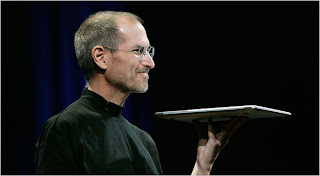


Steve Jobs introduced Apple's new Macbook Air at MacWorld Tuesday in SanFrancisco.

The MacBook Air also features a built-in iSight webcam and a full sized MacBook-style black keyboard. The keyboard is backlit, similar to MacBook Pros, and has an ambient light sensor that automatically adjusts brightness. The trackpad is also capable of recognizing multi-touch gestures, similar to using an iPhone or iPod touch. As a result, the MacBook Air's trackpad is disproportionately large, compared to the size of trackpads found on the MacBook or MacBook Pro.

The MacBook Air features a 1.8-inch hard disk drive with 80GB of storage capacity standard. A 64GB solid-state disk (SSD) drive is an option. The hard drive is a Parallel ATA (PATA) model that operates at 4200 RPM.

The laptop is powered by an Intel Core 2 Duo chip running at 1.6GHz, with 1.8GHz available as an option. Jobs noted that Intel was willing to engineer a new version of the Core 2 Duo specifically to Apple's specifications -- it's 60 percent smaller than others. The chip operates with 4MB of on-chip shared L2 cache running at full processor speed, and uses an 800MHz frontside bus. 2GB of 667MH DDR2 SDRAM is also included.

Like the MacBook and the MacBook Pro, the MacBook Air features a slimmed down MagSafe connector for power. It comes with a 45 watt power adapter. A flip-down door on one side reveals USB 2.0, Micro-DVI (to connect an external display) and a headphone jack. The MacBook Air also includes 802.11n-based wireless networking support and Bluetooth 2.1 + EDR.

Apple estimates that with wireless networking turned on, the MacBook Air can get about 5 hours of battery life.

No internal optical drive is included, but Apple will offer a $99 USB 2.0-based add-on SuperDrive for users who need it. For users that opt not to get the optical drive, Apple is offering a new software feature on this machine called Remote Disk; it enables you to "borrow" the optical drive of another Mac or PC on the same network as the MacBook Air, to use for installing software, for example.

Apple's frequently been in the crosshairs of environmental group Greenpeace in recent years. Jobs offered information about the environmental goals behind the MacBook Air -- it has a fully recyclable aluminum case, and is "the first" to have a mercury-free display with arsenic-free glass. All the circuit boards are BFR-free and PVC-free, and the retail packaging uses 56 percent less material than the MacBook packaging.

Apple introduces iTunes Movie Rentals

Apple on Tuesday introduces iTunes Movie Rentals, a new feature of the iTunes Store that enables users to download movies and watch them for a short time rather than having to buy them. Movie rentals will be priced at $3.99 for new releases and $2.99 for older films. High Definition (HD) movies will be downloadable only via Apple TV and will cost $4.99 for new releases and $3.99 for older films.

The new feature is dependent on iTunes 7.6, a new release of Apple's jukebox, music, TV and movie software that's available for download from Apple's Web site. It also requires an update to QuickTime, version 7.4. That update is accessible through the Software Update system preference.

Apple's managed to get the support of all the major movie studios, including Fox, WB, Disney, Paramount, Universal and Sony, along with Touchstone, Miramax, MGM, New Line and Lions Gate. Apple CEO Steve Jobs said that the new service will launch shortly, and by the end of February will contain over 1,000 movies. Movies will become available for rental on iTunes 30 days after they are released on DVD.

iTunes Movie Rentals are tied to the Digital Rights Management technology used by Apple for other content purchased from the iTunes store. You can download movies and watch them from a Mac, PC or Apple TV. Movies downloaded on a Mac or PC can be transferred to an iPod, iPhone, or Apple TV. And Jobs indicated that you can transfer movies downloaded on Macs or PCs to other devices while you're in the middle of watching it, letting you pick up where you left off.

Movies downloaded directly via Apple TV, in contrast, will only be playable on Apple TV. Apple VP Greg Joswiak described standard-definition Apple TV movie rentals as "DVD quality," while non-Apple TV rentals are downloaded in a "near-DVD quality" format compatible with Macs, PCs, iPods, and iPhones. High-definition rentals are full 720p films with a Dolby Digital 5.1 soundtrack.

According to Jobs, after downloading a movie rental you have up to 30 days to start watching the movie. Once you begin watching, you have 24 hours to watch the film as many times as you want. Jobs said that users with modern Internet connections will be able to begin watching rentals within 30 seconds of initiating the rental download.

The new service is being offered as a free update for iTunes users in the United States beginning today. Jobs said that Apple is "dying" to get this feature to an international audience, with that release due "later this year."

Apple TV untethers from Mac, price dropped

On Tuesday Apple revamped its Apple TV media-playback device, lowering its price and completely changing its interface and adding numerous new features, most notably the ability to rent movies and purchase music and TV shows directly via the device.

During his Macworld Expo keynote address, Apple CEO Steve Jobs said the new and improved Apple TV software will be available in about two weeks as a free update to existing Apple TV devices. The entry-level 40GB model had its price dropped to $229, while the 160GB version now costs $329, a $70 price reduction for both.

In presenting the new software, Jobs showed a remarkable amount of humility about the product's first iteration, though he did suggest that Apple is not alone in having failed to solve the issue of providing digital downloads to the living room.

"All of us have tried," Jobs said. "We've all tried to figure out how to do movies, and you know what? We've all missed. No one has succeeded yet. We tried with Apple TV. Apple TV was designed to be an accessory for iTunes and your computer. It's not what people wanted. We learned what people really wanted was movies, movies movies. And we weren't delivering that. So we're back with Apple TV, take two."

The upgraded Apple TV operates as a standalone device. While it will still synchronize content with your computer, no computer is required to operate it. Once it's connected to your television and your computer network, you can rent movies directly on your widescreen TV, using Apple's new iTunes Movie Rentals feature, navigating using the Apple TV's remote. iTunes Movie Rentals cost $4.99 for new high-definition releases, $3.99 for older high-definition films and new standard-definition releases, and $2.99 for older standard-definition releases.

Apple said the high-definition films play at 720p resolution with many (but not all) available with a Dolby Digital 5.1 soundtrack. According to Apple, more than 100 high-definition movies will be available at first, with more coming "quickly."

Standard-definition films purchased on the Apple TV are of "DVD quality," according to Apple VP Greg Joswiak, and will not play back on Macs, PCs, or iPods. However, the Apple TV is also able to play back rentals purchased on a Mac or PC, albeit at reduced "near-DVD quality."

The Apple TV can also now be used to directly purchase TV shows and music, which will also automatically sync back to a Mac or PC via iTunes. A new podcast browser allows users to browse Apple's podcast directory and pick certain podcasts as "favorites" for quick access at a later time.

In addition to adding features that don't require a computer, this new version of the Apple TV software attempts to simplify the playback of media that does reside on computers in your home. By default, the software eliminates the distinction between media stored on the Apple TV's hard drive and stored on remote systems. For example, a single "My TV Shows" menu item lists all the TV shows in your possession, be they stored locally or remotely. Though media can still be managed manually, by default the system intelligently evaluates what files are best stored on the Apple TV's built-in hard drive and what files are best streamed across your local network.

The Apple TV can also display photos from online photo-sharing site Flickr as well as Apple's .Mac photo-sharing site.

Apple introduces Time Machine companion hardware

Apple Tuesday unveiled Time Capsule, a new product designed as companion hardware to the Time Machine automatic backup feature that highlights OS X 10.5.

Introduced as part of the OS X Leopard upgrade last October, Time Machine automatically backs up the contents of your Mac to an external hard drive.

Time Capsule fits into the picture by combining an 802.11n network access point and a hard disk drive. The device is a “full AirPort Extreme base station”—it bears an uncanny resemblance to Apple’s wireless base station—combined with “a server-grade hard drive,” according to Jobs

With Time Capsule, users will be able to go back through archived backups to find lost files, photos, digital media, and other data. Once the missing file is found, users can restore it wireless from Time Capsule; they can also restore an entire system from a Time Machine backup stored on the device.

Time Capsule features dual-band antennas for 2.4GHz or 5GHz frequencies. It has one USB 2.0, one Gigabit Ethernet, and three Gigabit LAN ports. The device also has a built-in power supply and can connect to print wirelessly from a USB printer, according to Apple. In addition, Time Machine offers Wi-Fi Protected Access (WPA/WPA-2), 128-bit WEP encryption, and a built-in NAAT firewall that support NAT-PMP for Leopard’s Back to My Mac feature.

Time Capsule ships in February in two capacities: a 500GB model for $299, and a 1TB version for $499.

More powerful maps, multi-person SMS lead new iPhone features

Apple expanded the iPhone's capabilities Tuesday with a free software update that adds a location finder to the Maps feature, customized home screens, multi-person SMS chats, and the ability to add Web sites to the home screen. In addition, video playback on the phone has been enhanced, with support for chapters, subtitles and languages, and lyrics support has been added for music tracks.

Apple CEO Steve Jobs unveiled the latest iPhone features during his Macworld Expo keynote.

The Maps interface has been streamlined in the latest update, with Search and Directions buttons in the middle; a button in the bottom right that curls up your map to offer the option to drop a pin anywhere you want, show traffic, and view in map, satellite, and hybrid views; and a button in the bottom left that finds your location on a map. Apple worked with Google and Skyhook Wireless to create the location feature. Google uses technology that looks for cell phone towers to triangulate your location while Skyhook uses 23 million mapped Wi-Fi hotspots. When it finds your location, Maps overlays a blue circle that shows your approximate position.

The iPhone's new Webclips feature lets you bookmark a Web page as a button on the iPhone's home screen. In addition to saving the site's web address, the Webclip icon remembers the Safari browser's page location and zoom settings, allow you to bookmark not just a single page, but a particular location on a page. To create a Web click, you navigate to a Web page in the browser, then click the plus-symbol icon at the bottom of the screen. When you choose the new Add To Home Screen option, the iPhone allows you to give your Webclip a custom name and then adds it to your home screen.

Speaking of the home screen, you can now move the icons on the home screen and rearrange them as desired. Hold down your finger on an icon and all your buttons will begin to shimmy, showing they are ready to be dragged around. You can also have up to nine screens worth of buttons, so you can put all your Webclips on a separate screen or move unused programs out of the way.

Video playback has improved with this update. When watching a video, you can now click on a chapters button to open the Chapter Guide. It shows you all the chapters in a video, along with thumbnails and the time at which they begin. And you can now take advantage of alternate languages or subtitles that are included in video files.

"The iPhone is not standing still," Jobs said.

According to Jobs, Apple has sold 4 million iPhones to date, averaging sales of 20,000 phones per day. That gives the iPhone a 19.5-percent share of the U.S. smartphone market as of the September 2007 quarter according to figures Jobs quoted from market-research firm Gartner. The iPhone only trails BlackBerry maker RIM, which has a 39 percent market share.

What's more, Jobs said, the iPhone's market share is equal to the combined percentage of the next three largest companies—Palm, Motorola, and Nokia.

Apple demands halt iPhone in China

Posted by Hitarth Jani | 7:39 PM | 0 comments »

Talks between China Mobile and Apple over the launch of iPhone handsets in China have been called off, officials at the Chinese company said.

"We can only say that negotiations have ended for now. We have no other news to report," said Li Honghui, a spokeswoman for China Mobile Communications, the parent of cell phone carrier China Mobile. She declined to comment further.

Rainie Lei, a spokeswoman for China Mobile, earlier Monday also declined to say why the talks ended.

"We have held talks with Apple to launch the iPhone device in China. However, those talks have ended," she said.

Calls to Cupertino, California-based Apple were not answered on Monday.

Citing an unnamed official at China Mobile's data services department, Chinese internet portal Sina.com reported Monday that China Mobile and Apple could not agree on revenue-sharing terms in their preliminary discussions, according to Dow Jones Newswires.

The official said China Mobile was unwilling to accept Apple's request for a 20 per cent to 30 per cent share of China Mobile's user fees from future iPhone users, according to the report.

Market watchers and analysts have said a breakdown in talks between Apple and China Mobile could open the way for rival China Unicom to offer the iPhone exclusively in mainland China.

China Unicom spokeswoman Sophia Tso declined to comment.

Eric Wen, an analyst at BNP Paribas, said the lack of an agreement would have little impact on China Mobile. But he said the failed negotiations could be a significant positive for China Unicom, which could start talks on an exclusive deal to supply the iPhone.

Wen said he believes China Unicom may be more willing than China Mobile to give Apple a larger percentage of user fees given its smaller share of China's mobile phone market.

Apple launched the iPhone in the U.S. in 2007 and has said it plans to launch the device in Asia this year. It hasn't disclosed any details on which operators in the region it might work with.

Analysts have said they expect Apple to launch the iPhone with one exclusive partner in each country in Asia, as it has done in the U.S. and in Britain.

Shares in China Mobile fell 2.8 per cent on Monday in Hong Kong to close at HK$130.2.

What will Apple do at Macworld this year to top last year's iPhone hoopla? Here are our best guesses.

A year ago, Steve Jobs strode onto the stage at Macworld Expo, pulled an iPhone out of his pocket, and set the tone in the tech industry for the next 12 months.

So with Jobs set to kick off yet another Expo with a keynote at the Moscone West convention hall this Tuesday, what will Apple do for an encore? Whatever it turns out to be, analysts say, it will be difficult to top the impact made by the Apple CEO at last year's Expo Keynote.

"The cell market is the largest in the world so it's difficult to upstage that," said Ross Rubin, director of analysis at market-research firm NPD Group. "It's hard to conceive what could be announced that would as anticipated as the iPhone was."

Michael Gartenberg, vice president and research director at JupiterResearch agreed: "I don't think we'll see something on the order of the iPhone," Gartenberg said. "Those are things that we see every few years, not every year."

But the safest bet heading into this week's Macworld Conference & Expo in San Francisco is that Apple will announce something. With an auditorium full of Mac enthusiasts and the industry press elbowing each other out of the way for a better view of whatever Jobs might have up his sleeve, the Apple CEO is unlikely to let his annual moment in the spotlight come and go without a headline-worthy announcement or two.

But what will it be? That's the question on the minds of every Expo attendee in San Francisco this week.

Potential Candidates

A rundown of Apple's existing product lines finds few potential candidates to make a big splash at Expo. The product in most need of an update-the high-end Mac Pro desktop-was revamped last week, theoretically so that it wouldn't steal the thunder from other Expo unveilings. Other Mac hardware, including the iMac or MacBook Pro, have seen updates of their own in the last six months. As for Apple's iPod offerings, the company overhauled the entire product line in September to take advantage of holiday shopping.

That's not to say, however, that Apple couldn't add a new product to one of its existing lines, which is why you hear so many rumors about a flash-based portable computer heading into Expo. Laptops remain a key part of Apple's business-the company sold more than 1.3 million laptops in its fiscal fourth quarter, which helped drive a second-consecutive quarter of record Mac sales. What's more, Apple has been without a small, lightweight portable targeted at high-end users since discontinuing the 12-inch PowerBook G4 upon its switch to Intel-built processors.

A slimmed-down laptop, analysts say, might appeal to executives or road warriors that need a powerful system, but don't need the features a full-fledged notebook has to offer.

"Ever since [Apple] stopped building the PowerBook 2400 there have been people begging Apple to return to the market," Gartenberg said. "They have resisted because they focus on products they can sell to the mass market. If they were to introduce this there would be some level of detail that we don't know about that would differentiate it from other products in this space."

Rubin agrees and says that Apple will need to overcome the problems that other manufacturers in this market have faced over the years-price, battery life and poor design.

Product Evolution

A new portable isn't the only product that could see an upgrade at Macworld. Gartenberg said he expects to see the evolution of existing products this week. For instance, Gartenberg points to the Apple TV-previewed in September 2006 and introduced in its final form at last year's Expo-as a device that got overshadowed by the iPhone last year.

"Apple TV got lost in the shuffle, but Apple hasn't abandoned that device," Gartenberg said.

To that end, reports have emerged that Apple and News Corp. have signed an agreement to offer Twentieth Century Fox movies for rent through the iTunes Music Store-other studios are rumored to be part of the negotiations as well.

Such a deal between Apple and any movie studio would immediately pump new life into the Apple TV. If the rental deal goes through, an update to Apple TV allowing the user to rent movies directly through the device could potentially make the device more appealing to some users.

Of course, rumors of iTunes-based movie rentals come at an interesting time for the digital media market. Last month, retail giant Wal-Mart discontinued its online movie download service after less than a year. At the same time, rent-by-mail service Netflix is stepping up its efforts, lifting limits on how long its customers can watch streaming movies. Some speculate that Netflix made the announcement this week to steal some of Apple's Expo thunder.

There's also the possibility that Tuesday's keynote could deliver more news about the product that caused all the hubbub a year ago. Reports of a forthcoming iPhone update that includes Google's My Location feature and the ability for users to control the icons on their home screen see very plausible.

Some Mac users have not been too keen on Apple using Expo to focus on devices like the iPod or iPhone, saying the show should be reserved for Macintosh products. However, NPD's Rubin doesn't think that should be the case.

"A lot of the focus last year was on the iPhone, which runs the Mac OS," he said. "If a Mac has been defined by its operating system in the past, we now have Macs called iPhone, Apple TV and iPod."

Third-party Companies

Apple certainly controls the tempo of Macworld Expo with its product announcements and glimpses into the future of the company. But Apple isn't the only company here - there are hundreds of third-party developers in San Francisco showing off their wares for the Mac, iPhone and iPod as well.

Developers big and small dot the list of 400 or so exhibitors, from soundtrack software maker Abaltat to open-source messaging software developer Zimbra.

Already, several larger developers have already unveiled products they plan to promote at Macworld Expo. Last week, Adobe took the wraps off its new version of Photoshop Elements for the Mac while FileMaker shipped its Bento personal database. Microsoft hopes to make the biggest splash by using Expo to officially launch its long-awaited update to its business productivity suite, Office 2008.

Still, Apple retains the spotlight at Expo. And while it seems that expectations are running as high as usual, few would be disappointed if Steve Jobs ends his keynote without an iPhone-like blockbuster.

"Apple has a really good Macworld track record," said JupiterResearch's Gartenberg. "I haven't seen an audience leave a keynote being anything other than satisfied in years."

Macworld will have live coverage of Steve Jobs' Expo keynote beginning at 9 a.m. PT tomorrow, January 15.

During a record-setting 2007, Apple (AAPL) rewrote its history with the success of the iPhone and continuing strong sales of the iPod line. This week, the company is expected to turn the focus to its roots: computers.

On Tuesday at the Macworld conference in San Francisco, Apple will show its new wares, with expectations running high among bloggers, fan sites and Apple analysts that the company will unveil a subcompact notebook computer.

"What will make this unique is its thinness, a good 50% thinner than existing Mac laptops," says Gene Munster, an analyst at Piper Jaffray. "Notebooks are the fastest-growing segment of the computer market. More people are bringing their computers everywhere with them."

He expects the notebook to skip the traditional hard drive and have built-in flash memory instead, which will help to make it ultra small.

The iPhone was introduced in June. Apple officially pegs sales at 1.4 million units through the third quarter. Munster projects that sales topped 3 million by the end of the year.

Apple CEO Steve Jobs is expected to introduce only "minor" upgrades to the iPhone, says Jason Snell, editorial director of Macworld magazine (whose corporate owner IDG stages the Macworld conference).

Snell thinks the iPhone, currently available with 8 gigabytes of storage, could expand to 16 GB. Apple in February will introduce specifications for outside developers to add applications to the iPhone, and Jobs is expected to offer a preview in his Tuesday address.

Jobs is also expected to announce the introduction of movie rentals via Apple's iTunes store, says Munster. Currently, movies from Disney and Paramount are offered for sale at prices from $9.99 to $12.99.

Munster and others expect movie rentals priced in the $2-to-$3 range.

The popularity of iPods and iPhones translated to record sales for Apple computers in its last two quarters. Apple's share of U.S. consumer computer sales jumped to 9.8% in the third quarter, from 7.6% in the same 2006 quarter.

"Two years ago, if you bought a Mac, you had to explain to your friends what you were doing," says Munster. "Not anymore. There's been a real change in people's perception."

Traffic to the Macworld website has risen 25% from last year, says Snell. "Apple used to be this weirdo computer brand, but not anymore. Now Apple means cool and easy to use, and it's not abstract anymore."

Some 50,000 people are expected to attend Macworld, up from 40,000 in 2007.

All eyes on Apple's new offerings

Posted by Hitarth Jani | 9:06 PM | 0 comments »

As the annual Consumer Electronics Show in Las Vegas winds down to lackluster reviews, Apple is expected to grab the spotlight with an ultra-slim laptop computer and online movie rentals at its biggest annual show next week.

The new products are seen more as enhancements to Apple's current offerings rather than ones that pack the "wow factor" of last year's star attraction, the iPhone.

Next week's annual Macworld event in San Francisco is the favourite venue of Apple Chief Executive Steve Jobs to roll out new products and chart the company's course for the year.

His showman-like pronouncements also increasingly set the agenda for the computer and electronics industries, and have in recent years overshadowed CES, held in Las Vegas around the same time.

Apple gives no hint of what will be announced, so guessing what Jobs has up sleeve is a favourite pastime of analysts and industry executives.

Analysts expect a computer half as thick as Apple's current MacBook lineup, but using flash memory chips like those found in its iPod music players rather than a hard drive.

"The energy seems to be around a smaller-form-factor laptop computer," said Charles Golvin, an analyst with Forrester, a market research firm.

Notebooks have been one of Apple's strongest segments. In its fourth fiscal quarter ended last September, the company sold 1.34 million MacBook and MacBook Pro laptops, up 37 per cent from a year earlier.

"What I'm guessing we might see from Apple is something a little more recognisable as a MacBook device, as a derivative of a laptop or tablet rather than a cool new form factor that sits between laptop and mobile phone," Golvin said.

Many also think Jobs will announce that customers will be able to rent downloaded movies from Fox, Warner Bros and others though its iTunes online store, a move that could shake up the $US9 billion US movie rental market.

"I think the rentals are a bigger deal," said Shaw Wu, an analyst with American Technology Research. "Apple has just simply not served that market yet and I think that's going to open up a whole new revenue opportunity."

Anticipation that Jobs will wow everyone with groundbreaking new products tends to drive Apple stock higher in the days ahead of Macworld, but can set shares up for a fall if the new products don't live up to expectations.

And Apple has fared better than other computer companies such as Dell, which has fallen 15 per cent since the start of the year, and Hewlett-Packard.

"Apple's still going to be one of the better names to be involved in in the tougher environment. The product cycles are so strong," said Wu, who has a price target of $US210 on Apple shares.

Many industry analysts see the polished message of Macworld as a welcome relief from the chaos of CES and its familiar parade of ever-larger televisions, sharper video cameras and slimmer cell phones.

"Apple didn't need to take thunder from CES, there was nothing to take," Michael Gartenberg, an analyst with Jupiter Research, wrote on the company's blog.

Wikia social search engine set for launch

Posted by Hitarth Jani | 7:59 PM | 0 comments »


Wikipedia's Jimmy Wales

A new collaborative approach to the field of search and potential rival to Google will be launched next week by the founder of Wikipedia.

Wikipedia founder Jimmy Wales says the goal of Wikia Search is to let volunteers improve search technology collectively, the way Wikipedia lets anyone add or change entries, regardless of expertise.

"That reduces the sort of bottleneck of two or three firms really controlling the flow of search traffic," said Wales, chairman of Wikia Inc., the for-profit venture behind the search project.

Wikia Search will be opened to the general public on January 7 after weeks of invitation-only testing.

Wales has said that current search engines - such as Yahoo and Google - are opaque services that don't explain how results are arrived at, IDG News reported.

AAP reports: Wales said taking the site won't dethrone Google Inc. or another major search engine - at least not soon.

Engineers at Google and other search companies continually tweak their complex software algorithms to improve results and fight spammers - those who try to artificially boost the rankings of their own sites. Search companies have not disclosed many details to avoid tipping off competitors and spammers.

Wales' approach would open that process. Initially, participants will help make such decisions as whether a site on "Paris Hilton" refers to the celebrity or a French hotel.

Wikia Search has assembled the basic technologies for a search engine, including a search application, search algorithm and Web crawler, according to IDG News.

The Search Wikia Labs website states that the future of internet search must be based upon transparency, community, quality and privacy.

Danny Sullivan, editor in chief of the industry Web site Search Engine Land, has his doubts. Finding all the web ites to index and staying ahead of spammers are huge undertakings, Sullivan said.

"I think he doesn't really understand the scale of what Google has to handle in terms of the queries from around the world and the amount of traffic that flows to it and the attempts that are made to try to manipulate it," Sullivan said.

Wales said the project would launch with about 50 million to 100 million Web pages indexed, a fraction of the billions available with major search engines.

Even as Wales tries to challenge search, Google has announced a project that could challenge Wikipedia. Google's version, called knol, will differ from Wikipedia by identifying who wrote each article and giving authors a chance to share in Google's advertising revenue.